

How long does it take to learn to ride a motorcycle? The answer to this question is one week, even you can learn motorcycle in just a few hours.
Your learning ability on a motorcycle depends on your experience. If you’ve driven the bike, then riding a motorcycle can be easy for you.
If that’s so, how long does it take to become a professional rider? How long does it take to do stunts on a bike? And can anyone learn to ride a bike?
We know you must have these questions, and we promise that you’ll get the idea of the ABC of learning motorcycles.
How Long Does it Take to Learn to Ride a Motorcycle:
You can learn to ride a motorcycle in just a few hours to a week, as mentioned above.
Learning motorcycles depends upon your history and the vehicle you’ve driven. If you ride a manual car, then riding a motorcycle will be a piece of cake for you.
Similarly, if you’ve driven a motorless bike, then balancing the motorbike won’t be hard for you.
If you haven’t driven a manual car, it might take a week to learn to ride a motorcycle. But if you’ve ridden any motorless bike in the past, then we’d recommend you to learn balancing on the motorless bike first.
As mentioned in our last post, during learning motorbike, some aspects are easy to learn, like shifting of gears and clutch. These easy-to-learn aspects take little time.
On the other hand, some are hard and time-consuming processes like using the throttle, balancing, and brake.
Additionally, making muscle memory is one of the most time-consuming processes that can take years to develop. Situation awareness and bike types also play a crucial role while learning motorcycles. For instance, naked and dirt bikes are more comfortable to learn and forgiving than sports bikes.
Don’t be so hard on yourself. Learning to ride a bike is a continual process.
Unfortunately, terrible experiences are the best teacher for learning to ride a bike. For instance, accidents help to sharpen your bike skills overall.
Pro Tipp: Watch YouTube videos of accident analysis, i.e. by DanDanTheFireman to improve your skills and avoid mistakes that lead to accidents.
How Long Does it Take to be a Professional Rider:
Let us tell you something. There is nothing called a professional rider.
As mentioned above, learning to ride a bike is a continuous process and takes your entire life to be an excellent rider.
Every time you go on your bike, you’ll find yourself in a new situation which adds to your experience.
And this experience increases your motorbike skills ultimately; it doesn’t matter if it’s good or bad.
Additionally, different motorbikes act differently, some are highly reactive and aggressive, and some aren’t.
Overall, no one can be a professional motorbike rider; it’s just another myth to be an experienced rider.
Can Anyone be a Rider:
Yes, anyone can be an excellent rider. But some people learn things more quickly than others.
The fast learners learn to ride motorcycles, cars, and other vehicles faster than others, but it doesn’t mean slow learners can’t ride motorcycles.
If you’re a slow learner, then don’t lose hope; always remember slow and steady wins.
Buy books, courses, hire a professional rider if you’re a slow learner.
With that said, learning motorcycles requires practice and learning. And not all people have much patience to learn and practice. Additionally, not all fast learners will be as good a rider as you.
Additionally, we don’t recommend you to compare yourself with anyone. Everyone has their unique path and different destiny to follow.
How Long Does it Take to be a Stuntman:
Some want to become a professional rider, while some want to be a stuntman. For your safety, we don’t recommend anyone to do stunts.
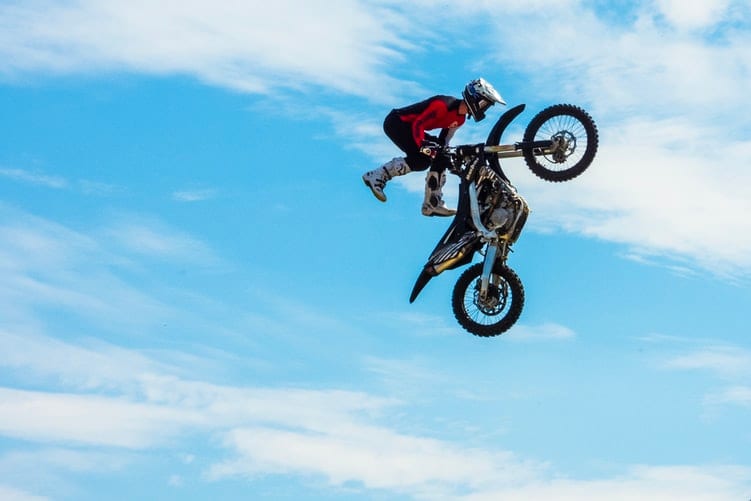
Just like becoming a professional rider, learning stunts on the road will take years to learn.
Learning stunts is a lifelong process, and even professional players lose their lives doing stunts.
It takes a bad and pleasant experience to become an excellent rider. Additionally, to be a stuntman depends highly on your practice and bike.
If you’re practicing 3 hours daily with your dirt bike, then you’ll be a professional stuntman in a matter of years.
Warning: We don’t recommend anyone to do stunts, as stunts can be life-threatening.
How to Learn Motorcycle Fast:
You can learn to ride motorcycles slow and steady, and there’s no need to learn motorcycles fast.

The proven and the only right way to learn to ride a bike is to take an MSF course.
MSF course not only helps you to get your license but also it’ll help you become an excellent rider. Highly professional teachers will teach you to ride a bike without being nervous.
The other best way to learn to ride a motorcycle is to read books and watch videos. These lessons can help you teach you the necessary skills you may need while riding a motorcycle.
The books and videos also help you increase your knowledge and understanding that protects you from unfortunate situations.
Last but not least, these above ways are only fruitful when you practice riding the bike instead of reading and watching.
We recommend you to practice as much as you can, because practice makes a man perfect.
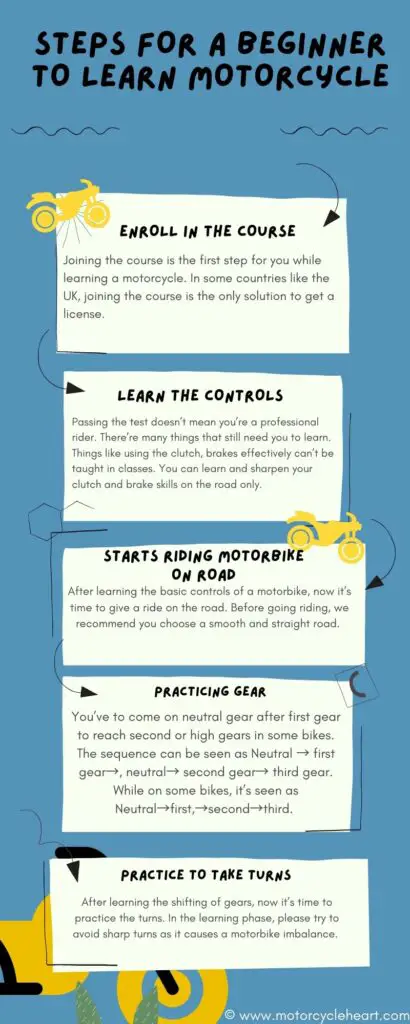
Steps for a Beginner to Learn Motorcycle:
So far, you learned about the average time duration that would take you to learn a motorcycle. Now it’s prime time to discuss the necessary steps to learn a motorcycle.
| Steps for a Beginner to Learn Motorcycle: |
| Enroll in the course. |
| Practice slowing your bike. |
| Start riding a motorbike now. |
| Practise gear. |
| Practice taking turns. |
| Learn using the controls. |
Enroll in the Course:
Joining the course is the first step for you while learning a motorcycle. In some countries like the UK, joining the course is the only solution to get a license.
While in some countries, the government recommends courses aren’t available to new riders. Here, we recommend you contact the local course provider.
Additionally, joining the course would help you learn the basic rule and ABC of the motorcycle which may protect you from various penalties and accidents.
Usually, these courses have online and offline classes both, and at the end of the course, you’ve to give a riding test to get your license.
Learn the Controls:
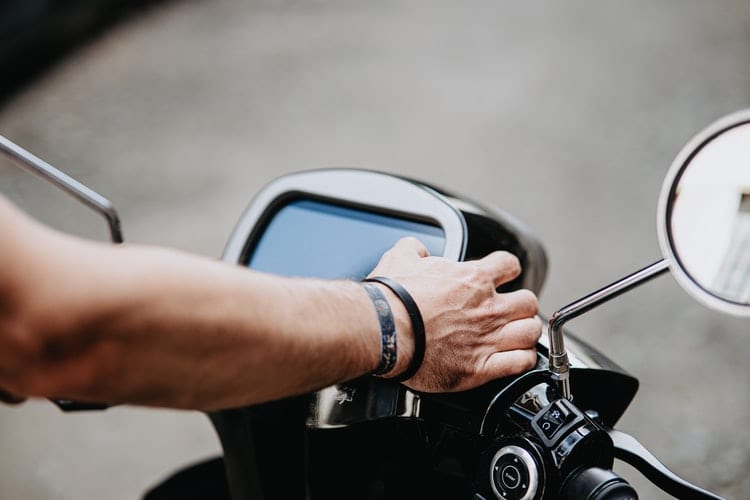
Passing the test doesn’t mean you’re a professional rider. There’re many things which still need you to learn.
Things like using the clutch, brakes effectively can’t be taught in classes. You can learn and sharpen your clutch and brake skills on the road only.
The value of using controls is underestimated, and it can be dangerous or even life-threatening if you can’t control effectively.
Starts Riding Motorbike on Road:
After learning the basic controls of a motorbike, now it’s time to give a ride on the road. Before going riding, we recommend you choose a smooth and straight road.
While starting on the bike, you’ve to press the clutch and switch to first gear from neutral gear. After doing this, leave the clutch slowly and at the same time give throttle.
Warning: Don’t give throttle and leave clutch too quickly; doing this will cause an imbalance of the motorbike.
Practicing Gear:
After learning bike controls, now it’s time to learn shifting gears effectively.
You’ve to come on neutral gear after first gear to reach second or high gears in some bikes. The sequence can be seen as Neutral → first gear→, neutral→ second gear→ third gear. While on some bikes, it’s seen as Neutral→first,→second→third.
Whatever the gear pattern is, you’ve to practice gears shifting effectively to be an excellent rider.
Practice to Take Turns:
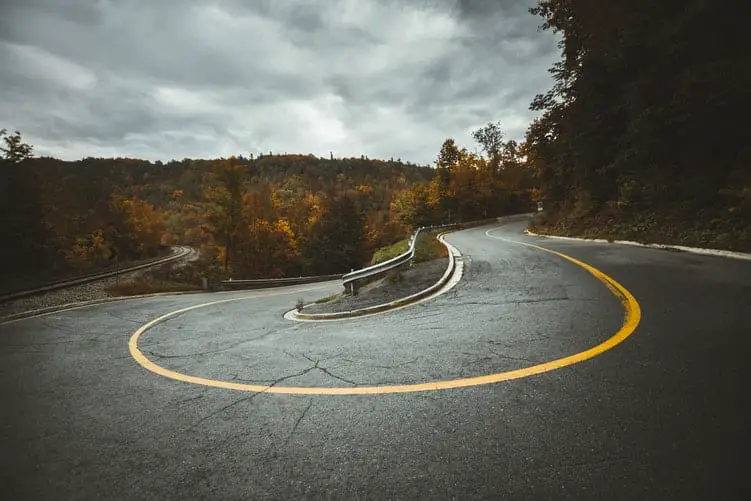
After learning the shifting of gears, now it’s time to practice the turns. In the learning phase, please try to avoid sharp turns as it causes a motorbike imbalance.
Before taking turns, don’t forget to give an indicator for your other riders around you. Most of the novice don’t slow their bikes and try to take a sharp turn. And doing this so causes accidents, and they injure themselves
Practice to Slow Your Bike:
After taking turns, now it’s time to practice slowing your bikes. We don’t recommend you to ride a bike with disc brakes, as these bikes can be dangerous for you.
Disc brake bikes cause the bike to stop suddenly and may cause imbalance. Before stopping the motorbike, we recommend you to decrease your gear from four to third, then second to first, and then finally neutral. Doing this will help you stop the bike safely.
Tips to be a Professional Rider:
Learning to ride a bike is easy. Well, it takes just a few weeks to be a professional rider for some people, but for some, it takes a few hours.
We don’t recommend you to hurry in learning to ride a bike; we want you to be a professional rider. Here’re some tips that will help you be an experienced rider.
Riding Means Safety First:
Most novices underestimate the importance of safety while learning the motorbike. We always recommend you wear your safety gear to protect yourself from any unfortunate situation.
While learning the motorcycle, you must wear a helmet, jacket, and rider pants to protect your full body.
Practise, Practise, Practise:
Practise is the only most precious tip that we can give you. Practice not only makes a man perfect but also helps to identify your mistake.
By practicing, you can know your mistakes and correct them to become a professional rider. Be a balancing, be a throttle, be a clutch; everything on a bike needs your practice.
Additionally, if you want to learn to bike quickly, then we’ll recommend you to practice more. No matter what book you’re reading and what video you’re watching, you can’t learn to ride a bike without practice.
Ignore the CC:
From the very beginning, we always focused on conveying the idea of choosing your bike as a low CC motorbike.
Choosing a high CC motorbike can be dangerous not only for you but for people around you. High CC motorbikes have the potential that a beginner rarely handles.
Overall, we recommend you start with a low CC motorbike.
Our Verdict:
How long does it take to learn to ride a motorcycle? Well, this depends upon your past driving experience. If you’ve ridden a manual car and motorless cycle, then it would take you a few hours to a few days.
Learning to ride a bike is a continual process and will last for a lifetime. A terrible experience will help increase your bike skills and help you be a professional rider.
At the end of this post, we want to conclude the entire article in one word “PRACTISE.” Practise is the only thing that’ll help you be a professional rider.
The more you practice, the more you will grow.
Quick answer
How long does it take to learn to ride a motorcycle?: Here’s the short version: identify the likely cause(s), confirm with a simple check, then fix the easiest/highest-probability items first. If the issue affects braking, steering, tires, or fuel leaks, stop riding and inspect before the next ride.
Related reading you may want open in another tab: Is it Hard for a Girl to Learn How to Ride a Motorcycle?.
Key questions (so you don’t waste time)
- Primary query: How long does it take to learn to ride a motorcycle?
- What tools/parts do you need before you start?
- What are the common failure points and how do you avoid them?
- How do you verify the fix worked (test/inspection checklist)?
At-a-glance guide
| Best first check | Tires/brakes/obvious leaks/loose fasteners |
| Best second check | Drive system tension/condition + electrical/battery |
| Stop riding if | Brake issues, steering wobble, tire damage, fuel leaks |
Step-by-step (practical)
- Confirm the symptom: reproduce it safely and note when it happens (cold/hot, RPM, speed, bumps, braking).
- Do the quick checks first: tire pressure/condition, chain/belt tension (if applicable), obvious leaks, loose fasteners, battery terminals.
- Isolate one variable: change one thing at a time (e.g., fuel, load, settings) and retest.
- Fix in a safe order: address safety-critical items first (brakes/tires/steering), then reliability items (charging/fueling), then comfort/noise.
- Verify: short test ride + post-ride inspection.
Checklist
- Tires: pressure, tread, age/cracks, punctures
- Brakes: lever feel, pad thickness, rotor condition, fluid level/leaks
- Drive: chain slack + lubrication (or belt condition)
- Controls: throttle free play, clutch free play, cable routing
- Electrical: battery voltage, terminals tight, main grounds
- Fluids: oil level, coolant (if liquid-cooled), fuel smell/leaks
Common mistakes
- Chasing “rare” causes first instead of checking the basics.
- Changing multiple things at once (you lose the diagnosis signal).
- Ignoring safety-critical symptoms (wobble, brake fade, fuel leaks).
- Over-tightening fasteners without a torque spec.
FAQ
Can I keep riding if this happens occasionally?
If it affects brakes, steering stability, tire integrity, or you smell fuel, don’t ride until inspected. For minor noise/vibration, do the checklist and monitor for change. See also: Is it Hard for a Girl to Learn How to Ride a Motorcycle?.
What’s the fastest way to narrow it down?
Reproduce the symptom, note the conditions, then do the “basics” checklist. Fix/confirm one item at a time. See also: Is it Hard for a Girl to Learn How to Ride a Motorcycle?.
What tools do I need?
At minimum: tire gauge, basic metric sockets/hex keys, flashlight, and a way to measure battery voltage. A service manual helps with torque values. See also: Is it Hard for a Girl to Learn How to Ride a Motorcycle?.
When should I go to a shop?
If you’re not confident with brakes/tires/steering, if a fix requires specialty tools, or if the symptom persists after basics. See also: Is it Hard for a Girl to Learn How to Ride a Motorcycle?.
How do I verify the fix?
Short ride close to home, then re-check: leaks, fasteners, tire pressure, brake feel, and that the symptom is gone. See also: Is it Hard for a Girl to Learn How to Ride a Motorcycle?.
Next steps (related guides)
- Is it Hard for a Girl to Learn How to Ride a Motorcycle? — how it differs from “How long does it take to learn to ride a motorcycle?”
Content refresh note: this post was updated to add an answer-first summary, a structured checklist, common mistakes, FAQ, and internal links for next steps.