

This is the ultimate comparison of BMW R nineT vs. Honda CBR 1000RR, and we will look at some essential features these machines have to offer.
In short: BMW R NineT Vs. Honda CBR 1000RR – Which One Is Better and Why. Verify the symptom, do the fast visual checks, then measure/adjust fundamentals before replacing parts.
If your issue affects brakes, steering, tires, or there’s any fluid leak, stop riding until it’s inspected.
Equipping street bikes with ample engine power is a real thing for the manufacturers because they need to keep it legal. Still, they also have to compete in the market without exceeding a specific price tag to keep the users interested.
Street bikes come with their limits, but you need to go for sportbikes or roadsters if you are looking for some serious punch in your ride.
We will discuss in this comparison of BMW R nineT vs. Honda CBR 1000RR are equipped with powerful engines and deliver a good fuel efficiency. It means they both are great for paved roads and traveling to longer distances for various purposes.
So, let’s skip to the chase!
Industry History
BMW

BMW is one of the top auto manufacturers that are well known for its high-quality engineering works. Their cars are one of the best in the world in terms of performance and power. And the same attributes can be associated with the brand’s motorbikes.
The brand has been producing motorcycles for a long time, but it has introduced new models with far more consistency and more innovation in recent years. It has become one of the leading manufacturers in this area too.
Honda

Honda is one of the leading auto manufacturers and has been heading the charts since 1959 as its top motorcycle manufacturer. Its motorcycles are known for reliability and long-term performance. When it comes to dependability, Honda is second to none.
BMW R nineT Vs. Honda CBR 1000RR – The Overview
The R nineT
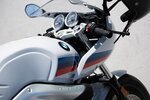
The R nineT is a top-notch roadster equipped with a very powerful engine and produces serious torque. BMW has equipped it with a twin-cylinder boxer engine that can manage a displacement of up to 1170cc. It’s a fast roadster, and its seating is comfortable as well. You can pick from various colors, including Black, White, and Silver, to match your personality. The bike also comes with a USB charging socket so you can charge your phones on the go.
The CBR1000RR

The CBR1000RR is a sportbike that comes in two colors. It is equipped with a four-cylinder engine that can manage a displacement of 998cc. The bike features a liquid-cooled engine and does a fine job by not getting overheated during those faster rides. The company has put maximum attention to peak its race track performance. The fuel tank is almost the same size, but BMW has a slightly bigger tank with 18 liters, whereas the Honda has 16 liters.
Comparison Chart
| Features | BMW R nineT | Honda CBR 1000RR |
| Fuel and vehicle type | Gasoline roadster | Gasoline sportbike |
| Fuel tank capacity | 18.0L (3.0L) | 16.0L (reserve 4.0L) |
| Displacement | 1170cc | 998cc |
| Maximum power @ 11000 rpm | 169 horsepower | 173 horsepower |
| Maximum torque @ 8500 rpm | 134 Nm | 129 Nm |
| Seating capacity | 1 | 2 |
| Weight | ~459 lbs | ~432 lbs |
| Gear transmission | 6 gear dry plate | 6-gear wet multi-plate |
| Front and rear suspensions | 46 mm telescopic fork and BMW Motorrad Paralever | 138.2 mm Unit ProLink HMAS and 62 mm Preload |
| Front and rear tire size | Spoke wheels 120/70 ZR 17 and 180/55 ZR 17 | Alloy wheels 120/70 ZR17 58W and 190/50 ZR17 73W |
| Battery | 12V – 14Ah | 12V – 7Ah |
| Seat type | Single | Dual stepped |
Engine
First, let’s talk about the engine in this comparison of BMW R nineT vs. Honda CBR1000RR. The BMW is equipped with a powerful boxer engine that can comfortably manage a displacement of up to 1170cc. It means this engine is capable of some break-neck speeds with an excellent lift.
In contrast, the Honda is equipped with a 4-cylinder inline-four engine that can operate smoothly at different speeds. However, handling will be a lot easier on the BMW boxer engine.
But at higher speeds, Honda’s inline engine will perform much better and for a longer period because boxers are not great when it comes to airflow at high speeds, which might cause engine failures at times.
Weight
There is not much difference between these two models if we compare them in terms of their body weight. The BMW roadster weighs just over 460 lbs, while the Honda sportbike weighs just over 430 lbs.
As you can see, there is not much difference between the two, but when it comes to handling, Honda’s sports bike is way better than the BMW roadster because of its more streamlined body designed for speeds. This round also goes to Honda in this comparison of BMW R nineT vs. Honda CBR 1000RR.
Suspension
Both these machines come with robust suspension systems. The BMW roadster features a 46 mm telescopic fork on the front and BMW Motorrad Paralever on the rear end. And it is built to take some toll even if you ride slightly unpaved roads as well.
On the other hand, Honda’s sports bike is equipped with 138.2 mm Unit ProLink HMAS on the front and 62 mm Preload on the rear end. This system is for paved roads. BMW’s system is much more versatile but also comes with some heavy maintenance costs.
This is not the case with the Honda’s suspension, and it goes down to your riding styles and where you prefer to ride your bike. So, this round is a tie in this comparison of BMW R nineT vs. Honda CBR 1000RR.
Ergonomics
Both the rides are ergonomic in their design and construction. But we got to give it to Honda here because their seats are very comfortable for longer rides, and for faster speeds, the bike is overall more aerodynamic.
Next: If you’re troubleshooting step-by-step, these will help:
- Triumph Tiger 1200 Vs. BMW R 1250 GS
- BMW R 1250 GS Vs. Harley Road King
- Ducati Multistrada 1200 Vs. BMW R 1200 GS
In comparison, the BMW is also built for speed, but its seat is a bit too stiff, and you will feel some fatigue when you get off the bike after riding for a longer session.
Both the machines have very ergonomic handles, and the footrests are nicely positioned too. So, this round goes to Honda in this comparison of BMW R nineT vs. Honda CBR 1000RR.
Aesthetics
In terms of looks and aesthetics, the BMW roadster is far superior to the Honda’s sports bike, that is, if you are a fan of a roadster and don’t want to go with its traditional sports bike design.
The BMW looks very classy and stylish with its modern looks, and you can customize it with four different finishes. The sports bike also comes in two colors, and the individuals who prefer to go old school and keep it traditional will prefer the looks of Honda with some variations of its own.
This round goes to BMW in comparing BMW R nineT vs. Honda CBR 1000RR but only a slight margin.
BMW R nineT Vs. Honda CBR 1000RR – The Similarities
Fuel type
Both these machines run on petrol to deliver a similar performance in terms of fuel consumption. Both these machines are relatively equal in terms of mileage, and it’s going to be very difficult to differentiate them in this department.
Gear transmission
Another feature that is similar in both these models is that they both come with 6-gear manual transmission. The only difference is, the BMW features a dry plate transmission while the Honda comes with a wet plate transmission. Both of them are highly effective in smoother transmission.
Braking system
Another feature similar in both these motorbikes is that they both come with a disc braking system to ensure you get plenty of stopping power on the road. Their configuration is slightly different as BMW features dual-disc on the front and single-disc on the rear end. Honda comes with hydraulic disc brakes on both front and rear ends.
Added features
Both these machines come with some add-ons like a speedometer, a tachometer, a gear indicator, a fuel warning indicator, along a fuel gauge. There are low battery and oil indicators and a clock, and an engine kills switch.
BMW R nineT vs. Honda CBR 1000RR – Pros & Cons
BMW R nineT
Pros
- Fully reliable and exceptional build quality
- Modern design with four different finishes
- Very powerful engine
- Large fuel tank
Cons
- Exhaust sounds are not that good
- Its fairing and mirror need to be altered in design for speeds
Honda CBR 1000RR
Pros
- Excellent streamlined body
- Build for high speeds
- Quick acceleration
- The sound is extraordinary
- Powerful yet smooth operation
Cons
- The engine lacks power in comparison to other motorbikes in this range
Conclusion
Now you know everything you need to make an informed decision. In our opinion, the winner of this comparison of BMW R nineT vs. Honda CBR 1000RR is the Honda sports bike because it’s more refined performance even at higher speeds. If speed is your ultimate goal, the BMW R nineT reigns superior.
We’re not discouraging you if you’re a BMW fan. But if you are looking for a durable, long-lasting bike that will provide you with a joy ride, you need to go with the Honda here. Its maintenance and repairs are much cheaper, and it also has a more streamlined and lightweight body than the BMW’s roadster.
Quick answer
BMW R NineT Vs. Honda CBR 1000RR – Which One Is Better and Why?: Here’s the short version: identify the likely cause(s), confirm with a simple check, then fix the easiest/highest-probability items first. If the issue affects braking, steering, tires, or fuel leaks, stop riding and inspect before the next ride.
Related reading you may want open in another tab: BMW K 1200 S Vs. Honda CBR 1100xx Blackbird – Which One is Better and Why? · Kawasaki Ninja 650 Vs. Honda CBR 650R – Which One Comes on Top? · Kawasaki Ninja ZX 12 R Vs. Honda CB1100 – Which One is Better and Why? · Kawasaki Z900 Vs. Yamaha MT-09 – Which One Is Better and Why?.
Key questions (so you don’t waste time)
- Primary query: BMW R NineT Vs. Honda CBR 1000RR – Which One Is Better and Why?
- Which option is better for your situation, and why?
- What are the real-world tradeoffs (cost, comfort, safety, maintenance)?
- How do you choose quickly if you’re unsure?
At-a-glance guide
| Best first check | Tires/brakes/obvious leaks/loose fasteners |
| Best second check | Drive system tension/condition + electrical/battery |
| Stop riding if | Brake issues, steering wobble, tire damage, fuel leaks |
Step-by-step (practical)
- Confirm the symptom: reproduce it safely and note when it happens (cold/hot, RPM, speed, bumps, braking).
- Do the quick checks first: tire pressure/condition, chain/belt tension (if applicable), obvious leaks, loose fasteners, battery terminals.
- Isolate one variable: change one thing at a time (e.g., fuel, load, settings) and retest.
- Fix in a safe order: address safety-critical items first (brakes/tires/steering), then reliability items (charging/fueling), then comfort/noise.
- Verify: short test ride + post-ride inspection.
Checklist
- Tires: pressure, tread, age/cracks, punctures
- Brakes: lever feel, pad thickness, rotor condition, fluid level/leaks
- Drive: chain slack + lubrication (or belt condition)
- Controls: throttle free play, clutch free play, cable routing
- Electrical: battery voltage, terminals tight, main grounds
- Fluids: oil level, coolant (if liquid-cooled), fuel smell/leaks
Common mistakes
- Chasing “rare” causes first instead of checking the basics.
- Changing multiple things at once (you lose the diagnosis signal).
- Ignoring safety-critical symptoms (wobble, brake fade, fuel leaks).
- Over-tightening fasteners without a torque spec.
FAQ
Can I keep riding if this happens occasionally?
If it affects brakes, steering stability, tire integrity, or you smell fuel, don’t ride until inspected. For minor noise/vibration, do the checklist and monitor for change. See also: BMW K 1200 S Vs. Honda CBR 1100xx Blackbird – Which One is Better and Why?.
What’s the fastest way to narrow it down?
Reproduce the symptom, note the conditions, then do the “basics” checklist. Fix/confirm one item at a time. See also: Kawasaki Ninja 650 Vs. Honda CBR 650R – Which One Comes on Top?.
What tools do I need?
At minimum: tire gauge, basic metric sockets/hex keys, flashlight, and a way to measure battery voltage. A service manual helps with torque values. See also: Kawasaki Ninja ZX 12 R Vs. Honda CB1100 – Which One is Better and Why?.
When should I go to a shop?
If you’re not confident with brakes/tires/steering, if a fix requires specialty tools, or if the symptom persists after basics. See also: Kawasaki Z900 Vs. Yamaha MT-09 – Which One Is Better and Why?.
How do I verify the fix?
Short ride close to home, then re-check: leaks, fasteners, tire pressure, brake feel, and that the symptom is gone. See also: BMW K 1200 S Vs. Honda CBR 1100xx Blackbird – Which One is Better and Why?.
Next steps (related guides)
- BMW K 1200 S Vs. Honda CBR 1100xx Blackbird – Which One is Better and Why? — how it differs from “BMW R NineT Vs. Honda CBR 1000RR – Which One Is Better and Why?”
- Kawasaki Ninja 650 Vs. Honda CBR 650R – Which One Comes on Top? — how it differs from “BMW R NineT Vs. Honda CBR 1000RR – Which One Is Better and Why?”
- Kawasaki Ninja ZX 12 R Vs. Honda CB1100 – Which One is Better and Why? — how it differs from “BMW R NineT Vs. Honda CBR 1000RR – Which One Is Better and Why?”
- Kawasaki Z900 Vs. Yamaha MT-09 – Which One Is Better and Why? — how it differs from “BMW R NineT Vs. Honda CBR 1000RR – Which One Is Better and Why?”
- MV Agusta F4 1000 R vs. MTT Turbine Y2K Superbike – Which One is better? — how it differs from “BMW R NineT Vs. Honda CBR 1000RR – Which One Is Better and Why?”
- Star Venture Vs. Road Glide – Which one is Best Touring Motorcycle — how it differs from “BMW R NineT Vs. Honda CBR 1000RR – Which One Is Better and Why?”
Content refresh note: this post was updated to add an answer-first summary, a structured checklist, common mistakes, FAQ, and internal links for next steps.